
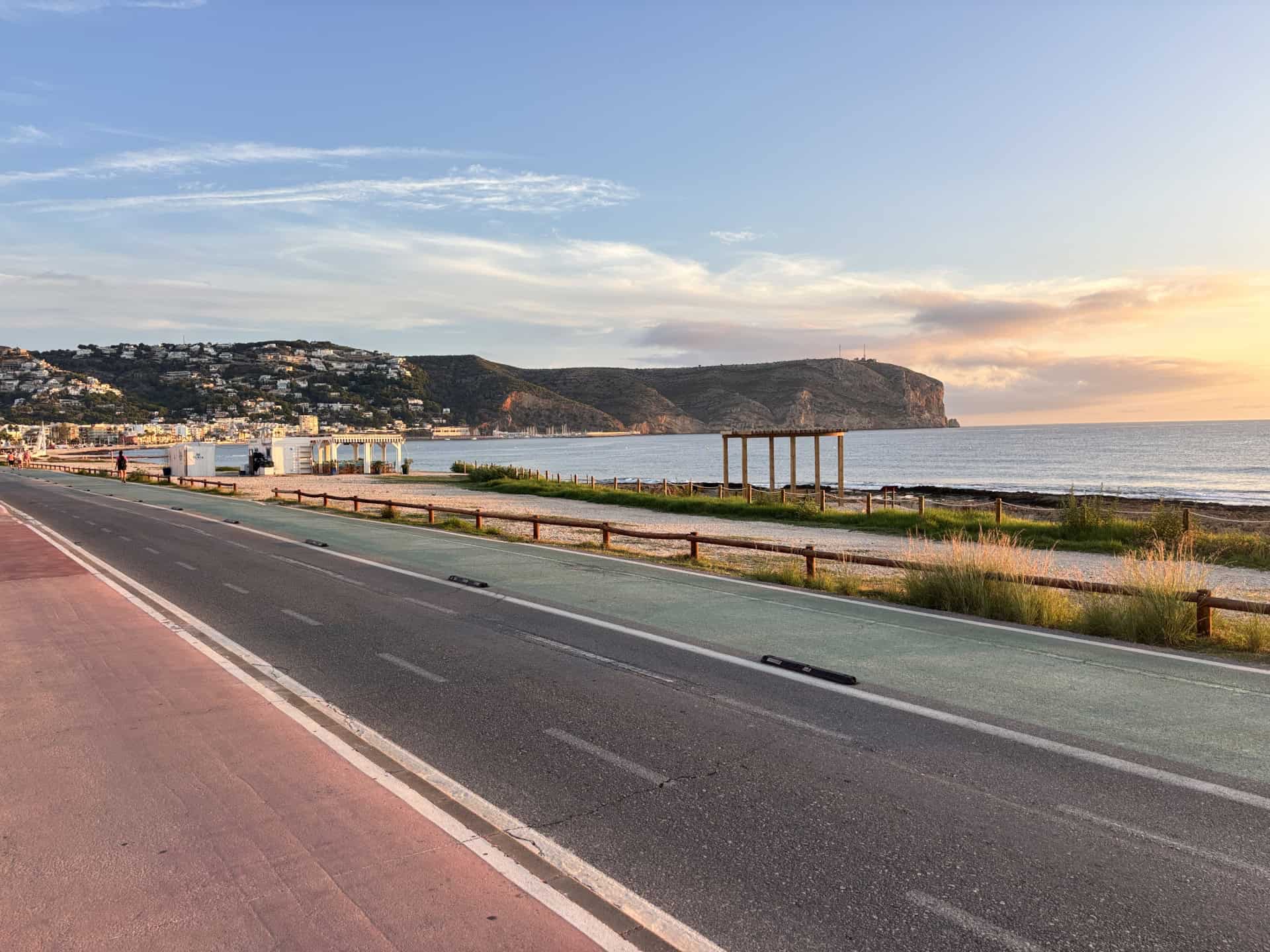
Bahía de Jávea runs along the rocky Montañar I coastline between the Arenal and the Port. On a map it reads like the section between two better-known zones, but living here is distinct. You’re close to both ends of the bay without being absorbed by either, and most days are shaped by the sea, the long flat walk and the steady pace of this part of Javea.
Long-term residents still call this stretch simply Montañar.
First Impressions
Bahía is open, flat and defined by the rock platform rather than sand. The sea sits close to the pavement, and the layout is straightforward: coastline on one side, a residential strip on the other. Mornings bring dog walkers, cyclists and people using the new benches to take in the water before starting the day.
From the path you see the curve of the bay in both directions: Cabo San Antonio towards the Port and the Arenal at the opposite end. Evenings feel calm because this section is used rather than “visited”, unlike the two end zones.
Old Frontline Villas, New Blocks
The frontline was once dominated by low, wide villas owned by well-known families from Javea, Valencia and Madrid. A few still remain, and they shape the older identity of the area.
Redevelopment has gradually changed the skyline. Some original plots were sold and rebuilt as apartment blocks. For second-line owners who bought expecting open views, this has been a long-running point of frustration. One new building can change the horizon completely, so planning decisions here often ripple through local conversations and, at times, pricing.
Today you see a blend of eras: established villas beside newer blocks, each representing a different stage of Bahía’s evolution.
The Rock Platform, Tosca Mines and New Walkways
Bahía does not have a sandy beach. The shoreline is a broad rock platform carved by the sea and, historically, by tosca extraction. You can still see cut marks where stone was taken for arches and façades across Javea until mining was banned in the late 1960s.
Recent works have added defined walkways, wooden rails, small viewing areas and benches. Information panels now explain the geology, the old quarries and a restored Civil War machine-gun post set into the rock. It forms part of a short memory route along the coast.
The improvements have organised the area, though the removal of seafront parking has impacted some local businesses.
Bars, Food and Everyday Spots
Bahía isn’t packed with venues, but the ones here are well used.
Siesta, almost on the rocks, is part of the Javea Company group. In season it draws a steady mix of swimmers, walkers and people stopping for a drink. Long-timers will remember the earlier version of Siesta from the 80s and 90s when it was little more than a bar with a couple of pool tables and big speakers that sent music across the rocks on summer nights.
Pepe y Estrella has been here for years and keeps its straightforward, old-school feel. Families tend to have their own stories tied to this place; it’s the kind of restaurant that becomes part of people’s personal Javea timeline.
Nearby is Cala Brisa, known for a calm, relaxed atmosphere. Monsoon Thai, one of the area’s better-loved Thai restaurants, also sits here for now, though they appear to be preparing a move closer to the Arenal.
For groceries, the nearest major option is Mercadona across Avenida Augusta. Residents typically use it for big shops and rely on the Arenal or Port for smaller, convenience trips.
Chiringuitos, Parking Changes and One-Way Traffic
Older photos show cars parked directly on the rock platform with a long run of summer chiringuitos. Parking has been pulled back and access controlled to protect the coastline. As a result, the number of chiringuitos has dropped and the area feels cleaner, though it does require more walking than it once did.
The road is now one-way between the Port and the Arenal, giving more visual and physical space to cyclists and pedestrians. Most residents now drive inland for practical trips and use Montañar I mainly for slow coastal movement.
The Grounded Yacht
In summer 2025, a 19-metre sailing yacht, Bau Bau, was driven onto the rocks during a storm and became stuck on the shoreline. For weeks it drew crowds, photos and debates about how and when it could be removed. Salvage work began later, but at the time of writing (December 2025) the yacht is still there. It has unintentionally become part of the landscape.
Noise, Atmosphere and Seasonal Feel
Bahía is quieter than the Arenal. Nights are shaped more by waves and light traffic than by bar clusters. Occasional music drifts from Siesta or Montgo de Bongo in season, but the overall feel is restrained.
Summer brings more walkers and people gathering at sunset. Winter strips the area back to locals, dog owners and people using the viewing points. The rock holds warmth into early evening, and the sea shifts to deeper blues once the summer haze disappears.
Who Chooses Bahía de Jávea
Bahía tends to attract:
• people who want to live by the sea without needing sand
• buyers who like the flat walk between the Port and the Arenal
• those who prefer a mix of villas and apartments rather than a single estate layout
• residents who want a quieter coastal setting with easy access to both ends of the bay
Bahía sits between the Port and the Arenal without trying to behave like either. That balance is part of its appeal: quieter, more lived-in and used daily by people who want the coastline on their doorstep without the intensity of the main beach area.
