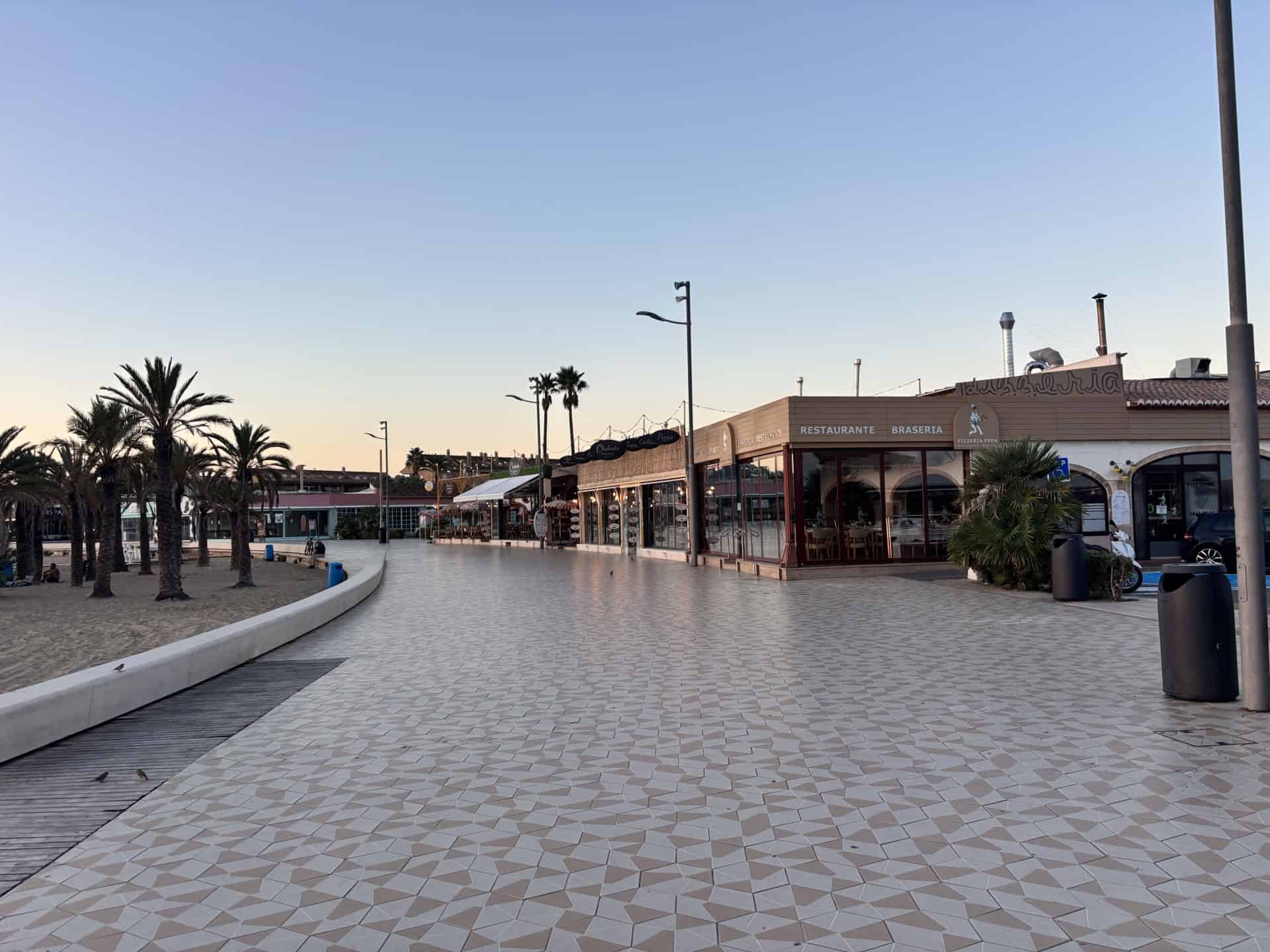
If you live around the Arenal you notice the small things first: the way the beach is already marked by the cleaning tractor before most people are up, the sound of chairs being dragged out onto terraces, the smell of coffee drifting from bars on the promenade. The place wakes up gradually. By eight or nine the promenade has a slow stream of people walking, jogging, heading to work or stopping for breakfast.
This sits within the wider Javea Overview guide. For the full neighbourhood structure, start with the main property in Javea page.
The apartments right on the front hear more of that – deliveries, the first scooters of the day, someone power hosing a terrace. A street back, along Avenida de la Libertad or into Javea Park, you hear everyday movement but not a lot else. Kids heading to school, dogs, the occasional car trying to squeeze into a space that’s always slightly too small.
As the morning goes on the promenade fills up a bit. Nothing rushed. Just steady use. People stopping for coffee, others cutting through to get to the sand, shop staff opening shutters. If you walk the whole stretch from the Parador end down past the volleyball courts and towards La Bambula, it’s a mix of cafés, restaurants, small shops, estate agents and the odd souvenir/beach swag place. You get used to seeing the same faces doing the same circuit.
Shopping here changed a bit after the old Mas y Mas by the beach closed. Most people now use the larger Mas y Mas on the roundabout opposite the Wok restaurant. It has enough space that you can shop without weaving around people every few seconds (unlike the old Mas y Mas). It’s on the main Cabo La Nao road, so you swing in and out easily. Consum up by Camí Cabanes is the next option, reached in minutes by heading inland. For big shops you need to drive to Mercadona or Lidl, which sit just outside the Arenal zone but close enough that you don’t think twice.
The “China shops” in the area fill in the gaps. They are literally warehouse type shops selling everything you could possibly imagine and more. You end up using them far more than you’d expect. People who’ve lived here a while know exactly which one has the better hardware shelf and which one has the cheap kitchen bits.
Eating out is split between the seafront and the back streets. The promenade has the obvious places – La Fontana, La Perla, Posidonia, Carnaval, Lungo Mare, Chabada. Most have wide terraces facing the beach. In summer they’re packed. In winter you sit behind the glass screens and still get sun at lunchtime. A block back, on Avenida de la Libertad and the cut-throughs towards Avenida de París, there are smaller spots: tapas, pizzas, cafés. You end up using these more often than you expect because they’re quieter and easier on weeknights.
Wok Jávea on the Cabo La Nao road is the go-to for quick buffet meals. You don’t plan a special night out there, but everyone living in the Arenal has eaten there at some point simply because it’s close and uncomplicated. It’s also fairly cheap and consistent. The Chinese restaurant Montaña de Oro by the main parking area is similar – not flashy, but reliable.
The buildings around the Arenal are a mix. The front-line apartments have balconies over the sea and commercial units underneath. Some buildings are old, some renovated, but the setup is predictable. The second line – Avenida de la Libertad – has smaller blocks, cafés, boutiques, and corners that go quiet by late evening. Further back, around Javea Park and Avenida de París, it feels more like a regular neighbourhood. People walk dogs, chat outside bakeries, and head to the skate park.
Most of the apartment complexes have underground garages. That matters more than you’d think. In August, trying to park on the street can take a while. In winter, garages stop your car fogging up every morning.
Living here is simple. You walk more than you drive. You head out in the evening without planning anything. The kids’ play areas are on the sand and in clear sight. The promenade is lit and flat, so a late walk is something you do without really thinking. The area doesn’t empty out in winter the way some coastal zones do; it just becomes calmer.
There are trade-offs. In July and August, especially at night, the Arenal gets busy. Parking is harder. You sometimes hear suitcase wheels on the pavement at odd hours. If your place faces the front, you hear nightlife in the distance on certain evenings. Some restaurants close for a few weeks in winter, and the smaller souvenir places shut until spring.
It suits people who like having things close. People who actually go for walks, stop for coffee, and use the beach. If you’re happier in quiet hills with space around you, the Arenal probably feels too active. But if you like being able to step outside and be somewhere within minutes, it’s hard to beat.
See also: Living in the Port